
Latest ARMS publication highlights advances in flexible energy storage
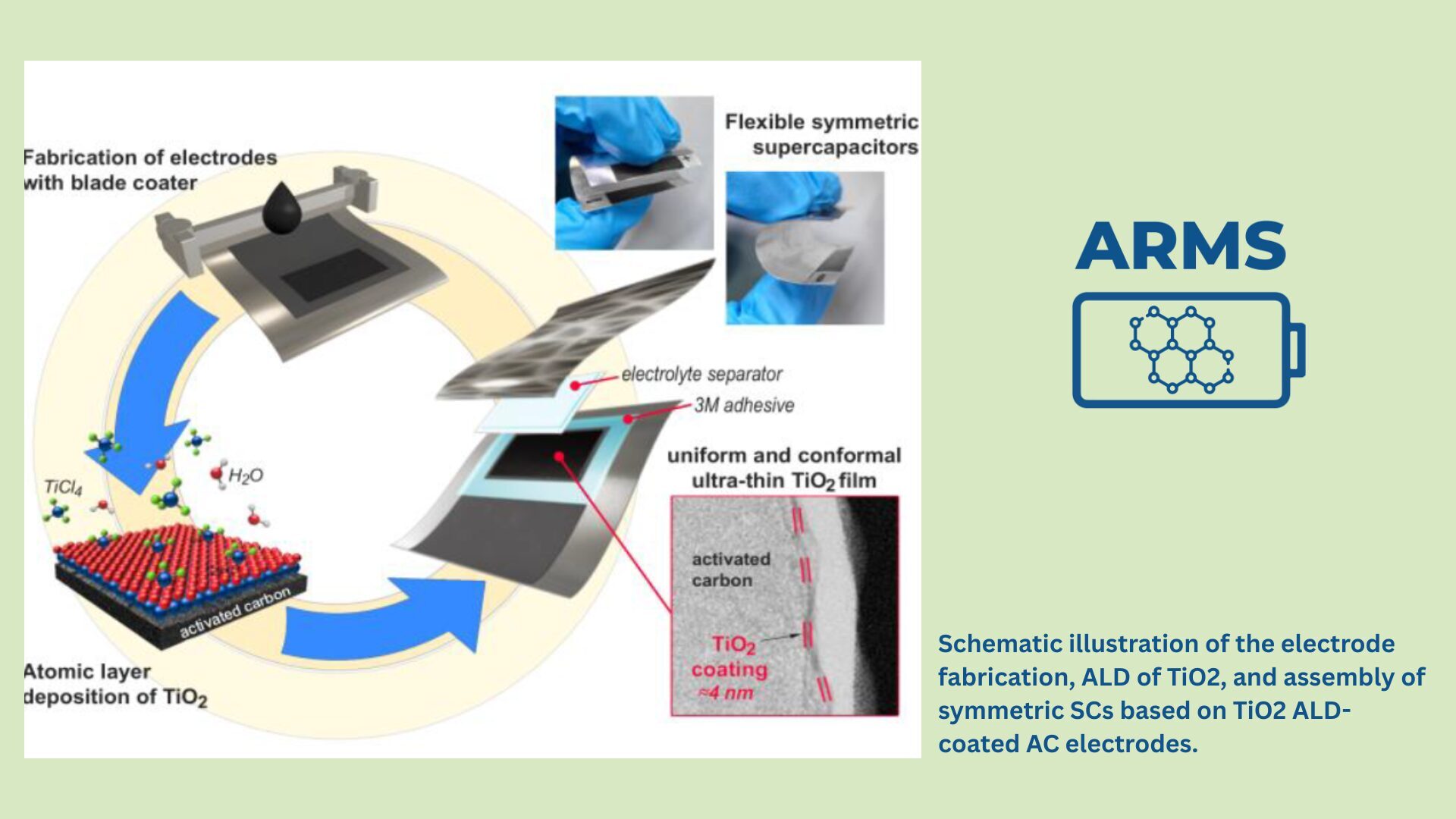
A new scientific publication, Charge-storage evolution of TiO₂ ALD-coated AC flexible supercapacitors over long-term cycling (DOI: 10.1109/FLEPS69128.2026.11645090), was published on 12 August 2026 in the proceedings of the 2026 IEEE International Conference on Flexible and Printable Sensors and Systems (FLEPS). The authors presented the study at the conference held 12-15 July 2026 in Atlanta, Georgia, USA. Authored by Remuel Isaac M. Vitto, Hamed Pourkheirollah, Jari Keskinen, Paul R. Berger (also affiliated with The Ohio State University, USA), and Matti Mäntysalo from the Faculty of Information Technology and Communication Sciences at Tampere University, Finland.
As flexible and wearable electronic devices become increasingly common, the need for efficient, reliable energy storage solutions is growing. Supercapacitors are particularly attractive because they can charge and discharge quickly while delivering high power. However, improving their energy-storage capacity without compromising durability remains a challenge.
In this study, the researchers explored activated carbon electrodes coated with an ultra-thin layer of titanium dioxide (TiO₂) deposited through atomic layer deposition (ALD). The coated electrodes achieved a capacitance of 34 F/g while retaining 98% of their performance after 10,000 charge-discharge cycles, demonstrating excellent long-term stability.
The researchers also observed improved charge-storage behaviour during long-term cycling. Increased surface accessibility and enhanced capacitive charge contributions improved capacitance by 16% initially and up to 32% after extended cycling, highlighting the effectiveness of ALD-deposited metal oxide coatings in enhancing the electrochemical performance of activated carbon while maintaining excellent cycling stability.
Overall, the findings demonstrate the strong potential of TiO₂-coated activated carbon supercapacitors for future flexible and wearable electronic applications, where reliable and long-lasting energy storage is essential.
The IEEE International Conference on Flexible and Printable Sensors and Systems (FLEPS) is a leading international forum dedicated to advances in flexible and printable electronics. The conference brings together researchers and industry experts working on flexible sensors, wearable devices, advanced materials, printed electronics, energy harvesting, energy storage, and smart systems, providing a platform for showcasing innovations that support the next generation of flexible technologies.