Advancing Sustainable Energy Storage: Highlights from the ARMS Workshop at FM&NT 2026
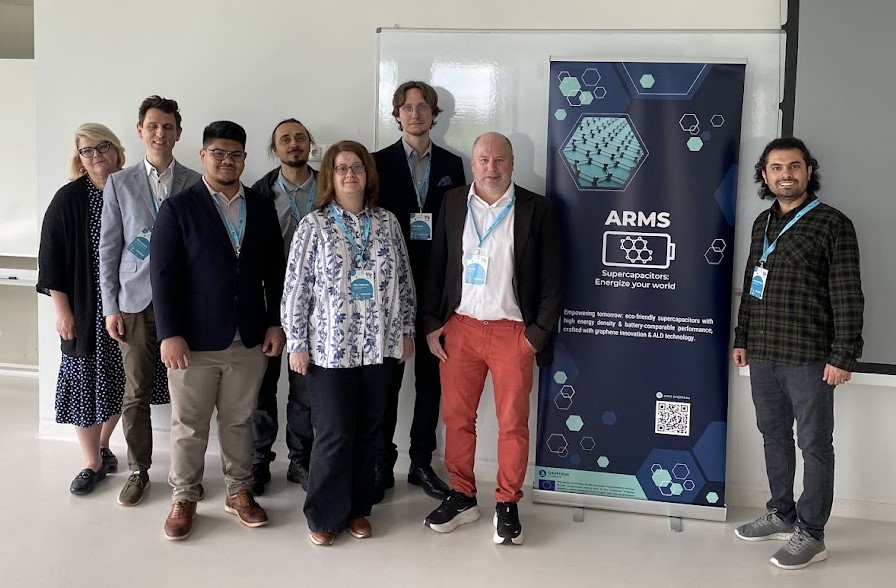 ARMS team (from left: Inese Jansone, Gints Kučinskis, Remuel Vitto, Aleksandrs Voļperts, Jūlija Hodakovska, Dāvis Kalniņš, Tero Pilvi,
Hamed Pourkheirollah). Photo: ARMS
ARMS team (from left: Inese Jansone, Gints Kučinskis, Remuel Vitto, Aleksandrs Voļperts, Jūlija Hodakovska, Dāvis Kalniņš, Tero Pilvi,
Hamed Pourkheirollah). Photo: ARMS
The session showcased how ARMS is driving innovation in sustainable, high-performance energy storage solutions, focusing on combining graphene-based materials with atomic layer deposition (ALD) to create next-generation supercapacitors. The project aims to deliver environmentally friendly devices with improved energy density while maintaining high power and long cycle life.
The workshop opened with a presentation by Hamed Pourkheirollah (Tampere University, Finland), who introduced the ARMS project and highlighted its progress in developing graphene-rich porous carbon materials, scalable fabrication routes, and eco-friendly electrolytes.
The focus on sustainability was further developed by Dr. Aleksandrs Voļperts (Latvian State Institute of Wood Chemistry), who presented advances in biomass-derived activated carbons. His talk demonstrated how renewable feedstocks, such as wood and other biomass sources, can be transformed into high-performance electrode materials, thereby supporting circular and environmentally responsible energy storage solutions.
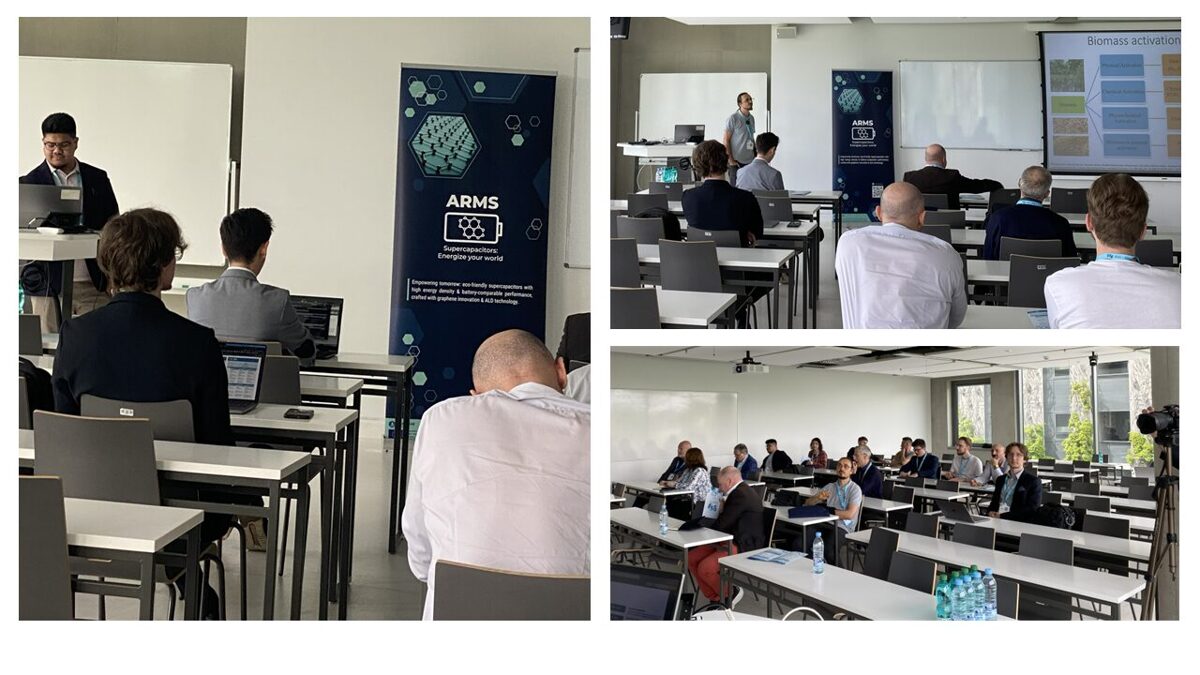
Providing essential scientific context, Dāvis Kalniņš (Institute of Solid State Physics, University of Latvia) guided participants through the principles of supercapacitors and electrochemical measurement techniques, emphasizing the importance of comprehensive performance evaluation to ensure reliable, comparable results.
Advances in material engineering were highlighted by Remuel Isaac M. Vitto (Tampere University), who presented how atomic layer deposition (ALD) can be used to enhance electrode performance. His work demonstrated that ultra-thin, conformal coatings can significantly increase capacitance by introducing additional charge-storage mechanisms while preserving the porous structure of carbon materials.
Bringing an industry perspective, Tero Pilvi (Beneq, Finland) addressed the crucial step from laboratory research to real-world applications. His presentation focused on the scaling up of ALD technologies, outlining how advanced coating processes can be translated into large-scale manufacturing for supercapacitors and batteries.
Overall, the ARMS workshop provided a dynamic platform for knowledge exchange, underlining the importance of collaboration between academia and industry. The presentations demonstrated strong progress across the value chain—from sustainable raw materials to scalable production technologies—reinforcing the project’s ambition to deliver next-generation supercapacitors that can compete with conventional energy storage solutions.